| Bioprinted Ear Transplants in Clinical Trials with 3DBio Posted: 02 Jun 2022 04:24 PM PDT Affecting one to five of every 100,000 children born, Microtia is a condition in which an individual has an undeveloped ear or no external ear features at all. Treatment may consist of creating an ear prosthetic or surgical reconstruction via rib cartilage graft. This latter case involves several operations in which rib cartilage is formed into an ear shape, growing it in place on the scalp, and then raising the ear into place. 3DBio Therapeutics hopes that it has found an easier path with bioprinting. 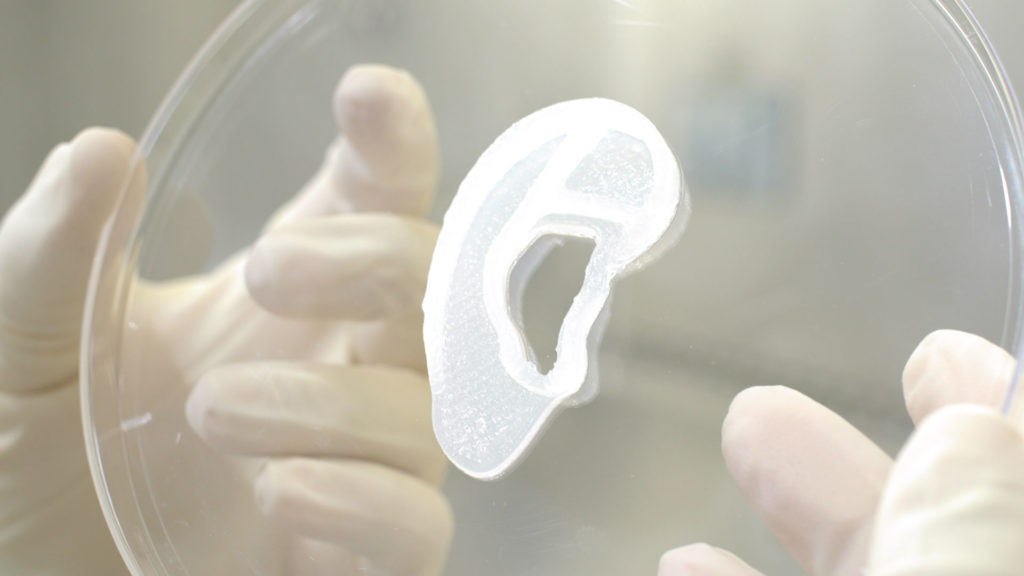
3DBio is a very credible company that includes Cornell professors Larry Bonassar and Hod Lipson. The latter is one of the sharpest minds in 3D printing and has done a lot of groundbreaking work for many years. The company is running a human Phase 1/2a clinical trial with 11 patients to test the efficacy and safety its AuriNovo product. Designed to mirror the patients’ intact ear, the AuriNovo is a bioprinted collagen ear implant made out of a hydrogel and the patients’ own chondrocytes (cartilage generating cells). Conducted by Cedars-Sinai Pediatric Plastic Surgery, the Microtia-Congenital Ear Deformity Institute, and 3DBio, the clinical trial started in 2021 and is set to run at the earliest until 2023, with the study ending in 2028 . "As a physician who has treated thousands of children with microtia from across the country and around the world, I am inspired by what this technology may mean for microtia patients and their families. This study will allow us to investigate the safety and aesthetic properties of this new procedure for ear reconstruction using the patient's own cartilage cells. My hope is that AuriNovo will one day become the standard-of-care replacing the current surgical methods for ear reconstruction requiring the harvesting of rib cartilage or the use of porous polyethylene (PPE) implants. The AuriNovo implant requires a less invasive surgical procedure than the use of rib cartilage for reconstruction. We also expect it to result in a more flexible ear than reconstruction with a PPE implant. The AuriNovo living tissue implant is designed to provide a better solution for patients born with microtia by transforming their appearance and building their confidence and self-esteem,” Pedriatric Microtia surgeon Dr. Arturo Bonilla.
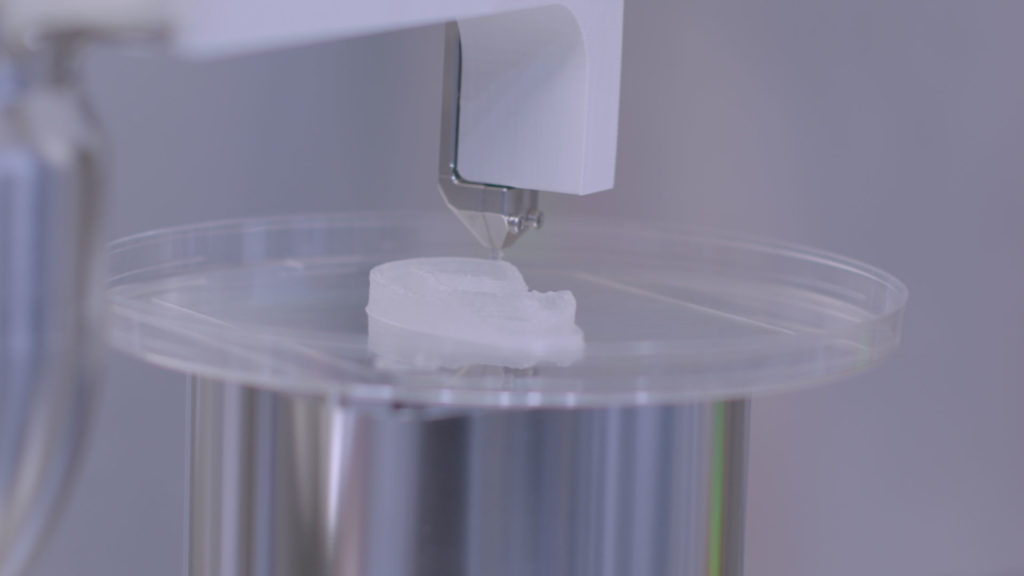
"This is a truly historic moment for patients with microtia, and more broadly, for the regenerative medicine field as we are beginning to demonstrate the real-world application of next-generation tissue engineering technology. It is the culmination of more than seven years of our company’s focused efforts to develop a uniquely differentiated technology platform meeting the FDA's requirements for therapeutic manufacturing of reconstructive implants," said Dr. Cohen. "We believe that the microtia clinical trial can provide us not only with robust evidence about the value of this innovative product and the positive impact it can have for microtia patients, but also demonstrate the potential for the technology to provide living tissue implants in other therapeutic areas in the future."Our initial indications focus on cartilage in the reconstructive and orthopedic fields including treating complex nasal defects and spinal degeneration."We look forward to leveraging our platform to solve other high impact, unmet medical needs like lumpectomy reconstruction and eventually expand to organs,” said 3DBio CEO Daniel Cohen. 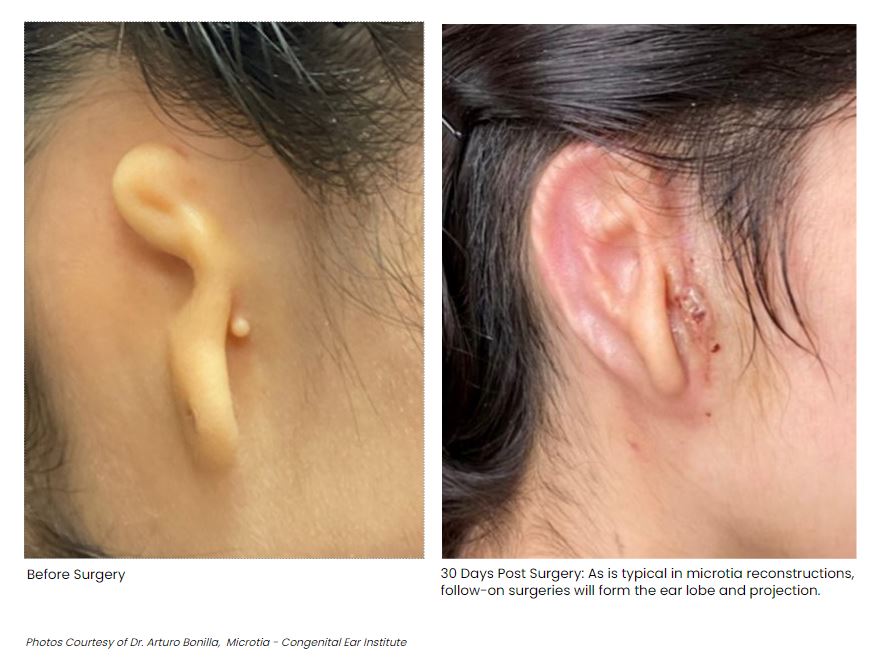
We’ve been looking at various 3D printed ear stories over the years, like this reconstruction and this UK clinical trial. I would expect a lot of similar products to emerge, should funding be available. It’s tough to think of any other bioprinted implant that is lower risk. The company has been working on the implant for seven years and hopes to parlay success in this area to a similar product for nasal defects, lumpectomies, and, later still, orthopedic applications, such as rotator cuff injuries, torn meniscuses, and herniated disks. This is a huge step forward for an impressive firm in an admirable field. The post Bioprinted Ear Transplants in Clinical Trials with 3DBio appeared first on 3DPrint.com | The Voice of 3D Printing / Additive Manufacturing. |
| Innovation for Electric Vehicles Polymer 3D Printing – An HP and 3DPrint.com Webinar Posted: 02 Jun 2022 08:03 AM PDT As additive manufacturing (AM) has matured, the technology is now primed for widespread adoption in the automotive sector. Already multiple vehicle manufacturers, including Volkswagen and Ford, have announced plans to mass produce parts using 3D printing. According to the "The Market for Additive Manufactured Polymer Automotive Parts: Europe and North America Regions" report from SmarTech Analysis, 3D printing in North America and Europe's automotive sector is expected to reach $2.7 billion by 2030. 
As global economies aim to shift to renewables, this will be particularly true for electric vehicles (EVs), where new production processes will be used from the start. Major automakers are now focusing on electric vehicle (EV) production with the goal of delivering zero-emission vehicles in the future. EVs have also becoming increasingly popular among consumers.  A 3D printed component made by BMW using HP’s Multi Jet Fusion technology. Image courtesy of BMW. To discuss the implications for AM in the EV sector, HP and 3DPrint.com will be hosting a webinar titled "Innovation in the EV Ecosystem with Polymer Additive Manufacturing." On June 9th at 10 AM PT, Aaron DeLong, Solutions Architect for HP 3D, and Wes Kramer, 3D Application Engineer at HP, will have a conversation moderated by SmarTech Executive Vice President of Research, Scott Dunham. Together, the group will cover the following topics: - How additive manufacturing can accelerate product cycles in electric vehicles;
- Optimization opportunities in fluid handling systems using additive manufacturing and topology optimization;
- Post-processing options to enhance surface quality, part functionality and achieve Class-A finishes.
Delong has spent more than 20 years in the automotive industry, much of which was with IAC, a tier 1 supplier devoted to interior plastics. Working in design, engineering, safety, and innovation, Delong saw AM used for prototyping, manufacturing aids, and general innovation. He joined HP in 2019 to support OEMs in using AM "as a cost avoidance tool in development, validation path and to address parts on vehicles through a production road map." Kramer supports the HP sales team with technical expertise of MJF 3D printing, including in-depth part cost analyses and 3D application selection. With a focus in post-processing and texturing, Kramer assists customers in achieving the most possible with their Multi Jet Fusion 3D printers and bringing end-use parts to market. Dunham has authored dozens of in-depth market research studies on numerous areas in AM, providing him with one of the widest perspectives on the technology worldwide. He has also spoken at many prestigious events and consults regularly for major companies, who rely on his data, forecasts, and insights for actionable intelligence. Speaking personally, Scott is one of the most knowledgeable people I've come across in AM. With that in mind, it's sure to be an enlightening webinar, even for those who already feel like experts when it comes to AM for automotive applications. The webinar takes place June 9 at 10 am PT. Register for the event here. The post Innovation for Electric Vehicles Polymer 3D Printing – An HP and 3DPrint.com Webinar appeared first on 3DPrint.com | The Voice of 3D Printing / Additive Manufacturing. |
| 3D Printing News Briefs, June 2, 2022: 3D Printers, Research, Tooling, & More Posted: 02 Jun 2022 06:30 AM PDT We’re starting off with news from Farsoon in today’s 3D Printing News Briefs, as the company has four new 3D printer models ready for the European market. Desktop Metal and Lumafield are combining their skills to improve the supply chain, and Pepsi Co. used Nexa3D’s technology to create tooling. Finally, Etteplan is supporting research that could lead to an AM breakthrough. Farsoon Expanding Portfolio in the European Market 
Farsoon Technologies promotes 3D printed series production of parts, and as such, has announced that four new models from its portfolio are ready to be launched in the European market. The company paid attention to customer feedback from Italy and Germany when developing the open models at its Chinese headquarters, and their performance has been validated with several customers in China, as well as at the HQ application center. This portfolio expansion, which was showcased at the recent Rapid.Tech 3D trade fair, will increase productivity of parts production, as well as target the higher quality and resolution of parts printed out of plastic and metal powders. The first new model is the Farsoon Flight-HT403P-2, with moveable cartridges, two scanners, and two 300 watt fiber lasers working to produce plastic parts using Farsoon’s special powder bed technology, Flight (fiber laser light). The Farsoon HT1001P-2 is the company’s largest laser sintering system, and features a high degree of automation, as it uses the company’s Continuous Additive Manufacturing Solution (CAMS), which automatically changes build cylinders after a job is complete. The new Farsoon FS422M-4 uses four lasers and scanners on a 420 x 420 mm2 build area, and the metal powder can be circulated in a closed loop; additionally, it also features a higher build height and optimized software. Finally, the Farsoon FS621M-4 meets the request for a much higher envelope with a 620 x 620 mm2 build area, making it what Farsoon says is “one of the largest laser melting machines available on the market.” Additionally, the printer’s powder filter systems enable a filter exchange without interrupting a print. Lumafield & Desktop Metal Strengthening the Supply Chain 
We know now that 3D printing was a big help to the supply chain during the many disruptions that the pandemic brought, but CAD models of each part are required. Lumafield, and its X-ray CT scanning technology, is able to digitize internal and external part features in detail, and is now offering a Supply Chain Resilience Package together with Desktop Metal and its range of AM solutions, so that manufacturers can quickly scan and reproduce important parts in-house to strengthen their own supply chain. Desktop Metal’s software and 3D printers can turn Lumafield’s mesh models into high-quality metal or polymer parts. The benefits of the Supply Chain Resilience Package include holding your place in line for delivery of a Lumafield CT scanner, 15 free CT scans performed at Lumafield’s facility while you wait for your Neptune, and application engineering support for 3D printing workflow mesh extraction. But, this deal only works if you reserve a Lumafield X-Ray CT system and a Desktop Metal 3D printer between May 1, 2022 and July 1, 2022. To activate the package, place a $1,000 refundable deposit for a Neptune CT scanner, and then share your invoice showing the purchase of a qualified Desktop Metal 3D printer, dated between May 1 and July 1. Desktop Metal machines included in this package include all of its metal printers, such as the Shop System, the Studio System, X-Series, and all Production System models, including the P-1 and P-50. Additionally, all ETEC DLP polymer 3D printers, like the D4K, P4K, Envision One XL, and Xtreme 8K, are included. PepsiCo Uses Hybrid Solution to Cut Costs & Time 
Generating over $79 billion in net revenue last year, PepsiCo‘s products include many tasty foods and drinks, with such iconic brands as Gatorade, Doritos, Mountain Dew, SodaStream, and more. Speed to market is vital in the consumer goods market, and the company needed a faster, less expensive way to create metal tooling for the blow molding of its many bottles. It can cost up to $10,000 to produce a metal tool set, and take up to a month, and while 3D printing could help, a blow molding tool printed in three days on a $250,000 PolyJet system out of pricey ABS is less durable. So PepsiCo worked with Dynamism, a partner of Nexa3D, to use a hybrid approach—3D printed inserts with a conventional metal mold—and get the job done. Dynamism validated Nexa3D's xPEEK147 from Henkel Loctite for printing the tool inserts, as the material is strong and has a high heat deflection temperature. They were printed on the high-throughput NXE 400 3D printer, which helped PepsiCo decrease its prototype tooling development time from four weeks to just 48 hours. Using its hybrid solution, the company can make a complete mold set in 12 hours, including eight hours of print time and four hours of curing. The resulting molds can be used to make more than 10,000 bottles, at a 96% cost reduction ($350 per mold set) in comparison to traditionally-made metal tooling. Etteplan Supporting AM Research Project in Sweden 
Finally, technology service company Etteplan, which specializes in software, embedded solutions, and engineering, is putting its additive manufacturing expertise to good use in supporting the ongoing ProThin AM project, which is part of the Swedish strategic innovation program Produktion2030. Led by RISE Research Institutes of Sweden AB, the project will last until 2024, and investigate the robustness of the laser powder bed fusion (LPBF) AM process. The main goal is to determine how to use LPBF technology to 3D print components with thin walls and narrow channels, and eventually set up a methodology that will allow for serial production of components with these features. All ten project partners will offer their particular expertise to the project; for instance, Etteplan will help with product design and process simulation. “Currently, it is possible to design complex components with such geometry, but reality and simulation are different. If you can't do simulations correctly linked to the LPBF behavior with the material properties, you can´t predict the reliability of manufacturing the components. This will save time, money, and material,” explained Niklas Eriksson, an additive manufacturing expert with Etteplan's Engineering Solutions Service. “If you can produce the desired structures, manufacturers can build products with higher functionality. The parts can be lighter and require less material. That would also result in parts that are more sustainable and environmentally friendly. “Our focus will be on simulation and design optimization for LPBF technology. Developing simulation workflows is very important and of great value regarding predictability and accuracy. We want to get more knowledge on the technical limitations to ensure that even complex parts fulfill the requirements.”
The post 3D Printing News Briefs, June 2, 2022: 3D Printers, Research, Tooling, & More appeared first on 3DPrint.com | The Voice of 3D Printing / Additive Manufacturing. |
| NASA Funds 3D Printing Research in 2022 SBIR/STTR Awards Posted: 02 Jun 2022 06:00 AM PDT Out of 333 proposals that NASA is funding as part of its 2022 Small Business Innovation Research (SBIR) and Small Business Technology Transfer (STTR) program, 24 are either creating new additive manufacturing (AM) processes or leveraging existing 3D printing technologies. Each project will receive a share of the $50 million NASA award, which is intended to develop technology to help drive the future of space exploration, as part of the agency's Phase I development stage. In May 2022, the agency revealed that the proposals from 257 small businesses and 41 research institutions would help address many of NASA's challenges in human exploration, space technology, science, and aeronautics. Notably, Jenn Gustetic, Director of early-stage innovation and partnerships for NASA's Space Technology Mission Directorate, said the uses for these technologies could even be destined for Artemis and other missions and the commercial space industry, and people's everyday lives. Each proposal team will receive $150,000 – a 20% increase over previous years' funding – to establish the merit and feasibility of their innovations. Phase I SBIR contracts are awarded to small businesses and last for six months, while Phase I STTR contracts are awarded to small businesses in partnership with a research institution and last for 13 months. 
In the last few years, NASA's SBIR/STTR program has seen dozens of AM-related projects for space innovations. For example, in 2021, NASA backed 36 3D printing submissions for Phase I, and before the pandemic, the agency funded another 10 AM projects. Based on their progress during this initial stage, the companies may submit proposals for $850,000 in Phase II funding to develop a prototype and subsequent SBIR/STTR Post Phase II opportunities. Among the innovative 3D printing undertakings this year, 3DPrint.com highlights six projects which have AM at its core: 3D Printing Anti-Radiation Construction One of the most important upcoming sectors of the space economy is construction on the surface of the Moon or Mars. For this reason, International Scientific Technologies, in conjunction with Virginia Tech, proposes the 3D printing of regolith combined with hydrogen-rich polymers to develop radiation-shielding structural materials for human habitats. The company proposes additively manufacturing structures on-site through in situ resource utilization (ISRU), that is, using the regolith available on the extraterrestrial surface with a minimal amount of hydrogen-rich polymeric binder, which would ideally be effective in deterring the incoming particles found in space radiation that would otherwise put crews at risk for radiation sickness, and increased lifetime risk for cancer, central nervous system effects, and degenerative diseases. Radiation shielding is crucial for space missions, so this is one of our favorite projects selected for Phase I. Outside of NASA, this technology will find applications in the U.S. Department of Defense and Homeland Security, helping protect soldiers, first responders, and emergency medical personnel against radiation resulting from dirty bombs and hazards from accidental release of radiological materials. 3D Printed Fuel Grains EOS Energetics (which goes by the business name Estes Energetics) is a spinoff company out of model rocket company Estes Industries that will develop a hybrid rocket motor for the next generation of sample return missions. Designed with Utah State University, the system will incorporate several unique technologies that provide the performance and reliability needed for a sample return propulsion system, including a high-capability electric ignition system, a high-performance oxidizer, and 3D printed fuel grains. According to the proposal, novel fuels like 3D printed fuel grains give more precise control over how fast fuel will burn inside a rocket casing, so for a sample return, the thrust can be optimized for a high launch followed by an efficient cruise phase. Aside from NASA sample return missions, other potential applications for the additively manufactured hybrid motor technology include satellite maneuvering, de-orbit propulsion, and applications where a traditionally energetic material fuel source poses safety issues. Defect Correction for In-Space AM Intelligent Optical Systems, a California-based startup focused on sensor solutions, will use its SBIR award to find a way to correct defects during in-space additive manufacturing. The team, led by electro-optical physicist Bradley Bobbs, will produce interrupted-build samples with simulated defects on an AM machine designed for use in space. It will then use laser ultrasonic testing (LUT) to run scans on them and further develop algorithms and software to enhance defect detection and identification from the scans. According to the team, LUT is the only currently viable method for in-line defect detection during the AM build, so they will attempt to make preliminary assessments to show the feasibility of integrating LUT into the AM machine. In addition, the company already has plans for Phase II, which include developing and testing a prototype in-line inspection system that would ultimately enable fully qualified AM parts on the surfaces of the Moon and Mars, to support sustainable exploration there and on the International Space Station. Off-Earth 3D Printed Data Collector Dedicated to producing novel circuits in unique processes for rugged applications, Ozark Integrated Circuits submitted a plan to 3D print a read-only memory (ROM) to collect data that can survive at up to 500°C, which is roughly the temperature on Venus's surface. According to NASA, prolonged Venus surface missions (lasting months instead of hours) have proven futile due to the absence of a complete suite of electronics that can function that long without protection from the planet's extreme conditions––think, hot enough to melt lead. The longest successful report is from NASA Glenn Research Center's JFET-R, showing two months of operation under Venus surface conditions. However, the agency desires computational analyses on the surface of Venus to better understand its greenhouse effect atmosphere and geology, and that means prolonged missions. Ozark's project will attempt to design, simulate, package, and characterize an all-additive ROM technology based on qualified materials up to technology readiness level (TRL)-5 in previous NASA SBIR programs. The system could also be helpful for other high-temperature environments, like Mercury, high-temperature avionics, re-entry, propulsion sensing, and controls, along with any application that needs very high-temperature data collection from geothermal exploration to health monitoring of molten salt reactors. Lunar Construction Another project that deals with off-Earth construction is Lunar Resources' proposal of a novel 3D printing construction system for the Moon. The innovative technique combines unique mass control in an ultra-energy-efficient pulsed power printing headset to perform direct additive manufacturing of lunar regolith without any reagents. If effective, the technology would allow 3D printing of lunar structures from lunar regolith and in-situ derivative materials by printing from any direction to make structures with geometries and complexity not before possible on the Moon. Specific NASA applications include manufacturing large-scale complex structures such as landing pads, habitats, roads, walls, shields, berms, and beams. Based in Houston, Lunar Resources is a corporate spinoff from various NASA and NASA-sponsored technology development programs and is focused on developing and commercializing space manufacturing and resource extraction technologies to catalyze the space economy. The company has been developing 3D printers for a while, mainly to repair broken satellites or build new ones (while orbiting Earth), but it's hoping its resource extraction technologies will allow the U.S. to create a permanent presence on the Moon. AM for Spacesuits and Structures Under two STTR awards, Nanosonic will partner with Virginia Tech. Together, they will develop nanolayered extruded textiles for next-generation spacewalking suits (or xEMUs), which will benefit several space programs, namely the International Space Station, Human Landing System, Artemis, Gateway, and Orion. In their second undertaking, Nanosonic will team up with Virginia Tech's composite coding experts to predictively yield repeatable and reliable multifunctional lightweight hybrid structures through design tools. Highly tailored materials using AM techniques are Nanosonic's expertise. The company is leading the development of innovative high-performance polymer composites through new 3D printing methods, including reactive nano-layered extrusion, FFF, and filament winding. For more than ten years, Nanosonic has used AM to create a wide range of applications, including RF components on flexible substrates. Together with Virginia Tech's AM expertise, they plan to synergistically blend and develop some of the applications NASA needs for space exploration. 
Other proposed research and development initiatives include a novel 3D printing technique to manufacture ultra-high temperature ceramic matrix composites with microgravity improved grain structure by Nanoarmor; an in-process X-ray sensor that can detect defects of AM parts by Advanced Analyzer Labs, and Polaronyx's additively manufactured radiation-tolerant bearing for deep-atmospheric probes destined to giant planets. The post NASA Funds 3D Printing Research in 2022 SBIR/STTR Awards appeared first on 3DPrint.com | The Voice of 3D Printing / Additive Manufacturing. |
| Women in 3D Printing Gets Boost from SME, Toure Weighs in Posted: 02 Jun 2022 05:30 AM PDT Women in 3D Printing (Wi3DP) has already done much to change the additive manufacturing (AM) landscape. Through a variety of projects, including its TIPE event, it has not only opened up dialogues about diversity equity and inclusion (DEI), but it has driven AM companies to consider DEI in their operations. Now, the global organization will have further resources to drive forward its mission of closing the industry's gender gap through a partnership with SME. Dedicated to the advancement of manufacturing in North America, SME is a decades-old non-profit student and professional association. The group has long played a role in AM, from its 1987 Rapid Modeling Clinic to assisting in the establishment of America Makes and the F-42 committee for additive standards at ASTM International. It now has membership that spans over 72 countries as it continues to expand its offerings, including educational resources and more.  Wi3DP Founder Nora Touré. Image courtesy of Wi3DP. As a crucial legacy organization in the industry, SME will be able to provide substantial support to the all-volunteer-driven Wi3DP group. Founded just seven years ago as a simple blog, Wi3DP has grown to become one of the largest AM communities in the world, with more than 80 chapters in 36 countries. Together, the two organizations will drive forward Wi3DP's mission of DEI in the 3D printing industry. The partnership between the two groups will include the Wi3DP's flagship TIPE 2023 Conference, dedicated to Technology, Industry, People and Economics. The event will now be co-produced and powered by SME alongside Wi3DP. This will enable further support for year-around engagement and education via digital platforms. Additionally, SME's 2023 RAPID + TCT event in Chicago will include a "Wi3DP Showcase" to introduce an in-person aspect to Wi3DP's virtual TIPE event. In a conversation with 3DPrint.com at RAPID + TCT 2022, Wi3DP founder Nora Toure explained how SME will contribute to the larger TIPE event. "We are going to have a nice showcase at RAPID in Chicago next year. We see it as being like an in-person experience of TIPE. It's important that TIPE stays virtual because it enables everyone around the world come and be part of that experience and get access to content, whether or not they're in the industry. So, we're doing to stay virtual, but are considering doing an in-person event maybe once every five years. It will be continuation of the virtual experience."
Wi3DP and SME will co-author the Diversity for Additive Manufacturing 2023 Annual Report, meant to measure DEI in AM and providing resources for making DEI accessible and actionable. With the help of SME, Wi3DP's existing educational program will also be expanded into the NextGen Mentorship Pilot program for developing the next generation of AM professionals. When a non-profit finds a larger sponsor, there's always a question of how that organization will remain true to itself going forward. Toure assured us that Wi3DP would remain independent: "SME won’t change the nature of Wi3DP. What's important for the SME team is to make sure we stay all-voluntary. Because that’s really our driving force. We still have a lot to do in terms of gender diversity, for sure, but we are the only ones today that have a strong enough voice to tackle diversity in all of its shapes and forms. And that is really important to us, as well. We don't exactly know how to tackle this yet, but we’re going to need as many people as we can because we know how big of a conversation that’s going to be. We also don't know if we are the right ones to have those conversations. So, we’re going to be looking for everyone’s power having that. And we don’t want to own it. As an industry, we need to do something. Like if you really want the industry to grow, we really need to do something about diversity. We all need to work together. There’s no way around that."
As the two organizations work together to expand the Wi3DP mission, we can be sure that the dialogue related to DEI in AM will continue. It will be exciting to see how this plays out in terms of material outcomes, with SME's resources surely propelling Wi3DP forward. Because there seems to be no real equivalent to Wi3DP outside of AM, there's a possibility that the concept of DEI grows beyond the realm of 3D printing and to industry as a whole. After all, SME is not limited to a single manufacturing technology, so hopefully they see the success that Wi3DP brings to its brand and apply similar models across the group. The post Women in 3D Printing Gets Boost from SME, Toure Weighs in appeared first on 3DPrint.com | The Voice of 3D Printing / Additive Manufacturing. |
| 3D Printing Financials: voxeljet’s First Quarter Net Losses a Concern in 2022 Posted: 02 Jun 2022 05:00 AM PDT "We are off to a good start," said voxeljet (NASDAQ: VJET) CEO Ingo Ederer as he delved into the earnings report for the first quarter of 2022 during an earnings call with investors. But even though revenue increased and there have been some outstanding applications with its binder jetting machines, the results reported by the company show another season of net losses. For the first quarter ended March 31, 2022, the German manufacturer of high-speed, large-format 3D printers and on-demand parts services reported a 14.3% increase in revenues to €4.6 million ($4.9 million) compared to €4 million ($4.3 million) in the same period last year, primarily driven by its on-demand services segment which escalated 63.3% year over year. Commenting on the growth, Ederer said, "It is great to see that this growth comes from a wide variety of applications: projects in space exploration in the US, large orders from the art and architecture sector in Germany, components for cooling of parts in electric vehicles in the UK, and so on. What we have seen in the past is that on-demand printing revenue is a leading indicator for future sales of 3D printers, so this makes us very optimistic for the rest of the year."
Since voxeljet's binder jetting technology is especially suited for high-volume manufacturing because of its potential to scale, it has customers from various industries, including automotive, aerospace, and general engineering. Ederer described a wide range of new applications of voxeljet technology, including a yacht company that is producing several thousands of advanced propellers, leading U.S.-based exploration companies making rocket parts more aerodynamic, carmakers who use voxeljet to make vehicles more lightweight and energy-efficient and even public Swiss university ETH Zurich developing 3D printed concrete structures. Even though its services segment is doing great, revenues for voxeljet's systems division, which focuses on the development, production, and sale of 3D printers, decreased 32.1% to €1.4 million ($1.5 million) in the first quarter of 2022 from €2.1 million ($2.3 million) in last year's first quarter. This change was mainly due to lower revenues from the sale of 3D printers in line with the lower number of transactions. Notably, the company sold one new 3D printer in the first quarter of 2022, compared to two new printers delivered in last year's first quarter. As a result, during this period, systems revenues represented 30.6% of the total, compared to 51.4% in last year's first quarter. Another downside to the company's first-quarter earnings is the reported net losses which amounted to €753,000 ($812,000) or 10 cents per share, compared to a net loss of €8.3 million ($9 million) or €1.51 per share in the prior year same quarter. Unfortunately, these results are considered a "going concern" for the company, especially since voxeljet has recognized continuous net losses during full-year 2021, 2020, and 2019 amounting to €10.6 million ($11.4 million), €15.5 million ($16.7 million) and €14 million ($15.1 million) respectively. Additionally, voxeljet had negative cash flows from operating activities in the three months ended March 31, 2022, as well as the years 2021, 2020, and 2019. Voxeljet attributed these losses to Covid-19-related lower demand in both its systems and services segments and said it is taking several steps to mitigate the situation. At the same time, management has been preparing to sell and leaseback voxeljet's properties located in Germany to address the situation. In that regard, Chief Financial Officer Rudi Franz explained to investors, "we are making good progress with the planned sale and leaseback transaction of our facility in Germany. If everything goes according to plan, we should be able to sign a deal in the next month. We expect proceeds of approximately €30 million from this transaction and plan to use these proceeds to repay debt."
Franz said they plan to repay all debt (roughly €27.4 million) with proceeds from the client sale-leaseback transaction of voxeljet headquarters in Germany. He also said that, luckily, the real estate value had appreciated significantly over the last years in the Bayern area, which is why the estimated value for the entire complex facility will roughly be €30 million, so it would theoretically all pan out.  The sand core is one example of the size the VX4000 can print. Image courtesy of voxeljet Overall, it seems voxeljet may not be performing as strongly as other competitors in the 3D printing industry. In fact, an article published by stock market online site Seeking Alpha reports that "voxeljet is the likely next takeover target," particularly now that Desktop Metal has acquired ExOne, another binder jetting technology manufacturer. When it comes to voxeljet stock, the company saw an upturn trend during the first two months of 2021, only to race back down to 2020 levels in the subsequent months. At the beginning of 2022, company shares followed that same downward trend, which continued in April and May. During the last month, shares of voxeljet oscillated between $4.50 and $3.86. Despite this, voxeljet has reaffirmed its guidance for 2022, expecting revenue for the second quarter of the year to be in the range of €5 million ($5.4 million) and €6 million ($6.5 million). For the full year, revenue could reach up to €30 million ($32.3 million), while net income (loss) for the fourth quarter of 2022 is expected to be neutral to positive. The post 3D Printing Financials: voxeljet’s First Quarter Net Losses a Concern in 2022 appeared first on 3DPrint.com | The Voice of 3D Printing / Additive Manufacturing. |